Sacramento Commercial Real Estate Mid-Year 2026: Where the Opportunities Are

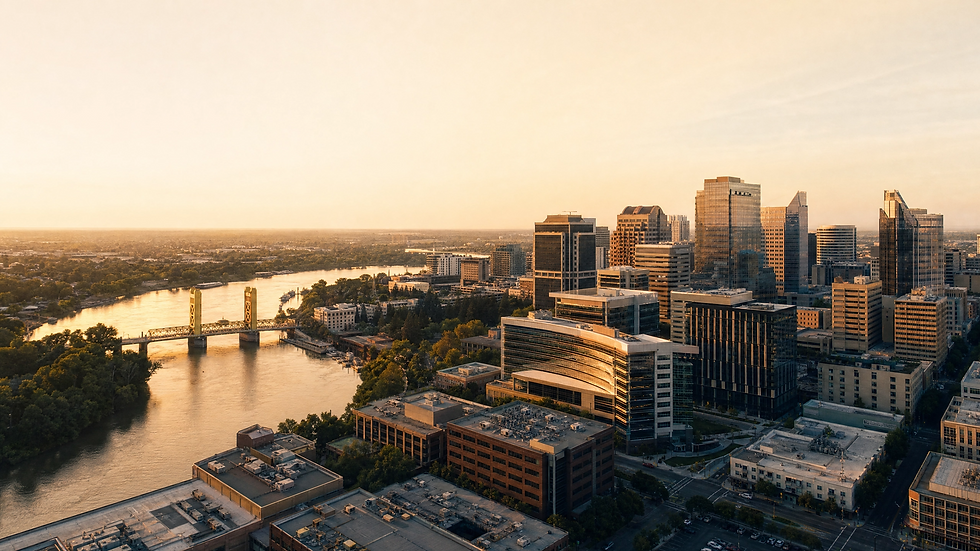
We're halfway through 2026, and Sacramento's commercial market is not the story most national headlines are telling. The shorthand version — "CRE is in a rough patch" — misses how stratified this region has become. Some corridors are tightening to sub-1% vacancy. Others are working through the highest vacancy levels in a decade. The investors and tenants who outperform from here will be the ones who can read the difference.
Here's what the Q1 2026 data tells us, what's likely shifting in Q2, and where I think the real opportunities sit going into the second half of the year.
The macro picture
Start with the demand side, because it's the part most outside-the-region observers underestimate. Sacramento has been quietly outpacing every other major California metro on net new residents, including San Diego, Los Angeles, and the Bay Area. State government expansion, infrastructure spending, and migration from higher-cost California markets continue to feed the regional economy. That's the wind at the back of every commercial decision being made here right now.
What the same data also shows is that 2026 is a recalibration year — not a contraction, but a reset. Capital is more disciplined. Tenants are pickier. Pricing is more honest. The deals that get done are getting done at fundamentals that make sense, not at peak-2022 assumptions. That's healthy. It just means strategy matters more than ever.
Industrial: the small-bay sweet spot
The headline number looks ugly. Q1 2026 closed with industrial vacancy in the 7–8% range depending on the source — up roughly 70 to 100 basis points from year-end — and net absorption ran negative by more than a million square feet. Sublease space is sitting at roughly three times the ten-year average.
If you stop reading there, you'd think the industrial market is in trouble. It isn't. Two things are going on.
First, the negative absorption was concentrated. One major tenant move-out in West Sacramento — Manna Beverage vacating roughly 900,000 square feet — accounted for the bulk of the quarter's negative number. Strip that out and the picture is much closer to flat than falling.
Second, the market is stratifying sharply by building type. Big-box, speculative warehouse product is digesting oversupply from the 2022–2024 build cycle. But demand for small-bay and shallow-bay industrial — the 5,000-to-30,000 square foot range — remains genuinely active. Contractors, distributors, service businesses, and last-mile users can't find quality space in this size band, and rents are holding. Asking rates have stayed flat at around $0.76–$0.79/SF NNN, up about 1.3% year-over-year — not blistering, but firm.
Where the opportunities are: Owner-users priced out of larger product, investors targeting functional small-bay assets in established corridors (Rancho Cordova's Highway 50 flex inventory is one to watch), and tenants who can sign now while landlords are still willing to negotiate concessions on second-generation big-box space.
Where to be careful: South Sacramento industrial posted a direct vacancy rate north of 23% — by far the region's highest. Most of that vacancy is concentrated in older, functionally obsolete buildings that newer Natomas and Elk Grove product is pulling tenants away from. The submarket isn't broken, but building selection matters more here than almost anywhere else in the region.
Office: the stabilization nobody's pricing in yet
Sacramento office is working through its highest vacancy in a decade — around 15.9% as of Q1 — and the temptation is to write the sector off. I'd push back on that.
The early-2026 signals are quietly constructive. Tenant demand is up 80 basis points year-over-year. Q1 leasing activity ran roughly 11% ahead of the same quarter last year. Net absorption was barely negative, at under 20,000 square feet. This isn't a market in freefall — it's a market that has stopped getting worse and is starting to find a bottom.
The catalyst on the horizon is the state's return-to-office mandate, which takes effect in July 2026. Sacramento is a state-government town, and a meaningful chunk of downtown's vacancy is tied to underutilized agency space. A formal RTO push won't fix the office market overnight, but it changes the absorption math materially over the next 12 to 24 months.
Where the opportunities are: Tenants who need professional space in the central business district can lock in long-term deals at rates and concessions that won't exist 18 months from now. Investors with patience and the right basis can underwrite well-located Class B and trophy Class A assets at pricing that already reflects the worst-case scenario.
Where to be careful: Suburban office parks with weak amenity packages or aging infrastructure don't benefit from the same dynamics. Selection is everything in this asset class right now.
Retail: the suburbs are winning, and so is Midtown
Retail is the asset class quietly outperforming. Two patterns are driving it.
The suburbs are absorbing real demand. Roseville, Folsom, and Elk Grove are anchored by essential services — grocery, fitness, personal services, restaurants — and benefit from dense residential growth in the surrounding submarkets. Elk Grove specifically captured roughly 12% of regional retail tenant search activity in early 2026, second only to the urban grid.
Midtown Sacramento is the tightest retail submarket in the region. Ground-floor retail along K Street, J Street, and L Street is running at some of the lowest vacancy rates in the county, with rent growth driven by food, beverage, personal services, and independent specialty operators. This is not distress — this is a high-functioning urban retail environment.
Where the opportunities are: Neighborhood and strip-center investment in growing suburban nodes, especially anchored by grocery or essential services. For tenants, securing space in established centers in Elk Grove, Folsom, or Rancho Cordova before rent growth accelerates. For value plays, the Stockton Boulevard corridor in South Sacramento remains the region's primary value-retail market with stable occupancy at meaningfully lower lease rates.
Multifamily: through the delivery wave, into normalization
Sacramento multifamily absorbed a historic wave of new deliveries in 2024 and 2025. Vacancy edged up to around 6.8% as the market digested that supply, and rent growth flattened in many submarkets. That's the bad news.
The good news — and the part that doesn't get said enough — is that the new construction pipeline has contracted sharply. Far fewer units are coming online in late 2026 and 2027 than the market has seen in years. That sets up a familiar pattern: occupancy stabilizes through the back half of 2026, and rent growth re-accelerates in 2027 once the absorption catches up to the slower delivery schedule.
Underlying demand hasn't gone anywhere. Sacramento remains attractive on quality-of-life and affordability relative to the Bay Area, which continues to feed regional renter demand.
Where the opportunities are: Acquisitions of stabilized multifamily assets at current pricing, before the supply-demand picture shifts back in owners' favor. This is also one of the strongest current categories for 1031 exchange replacement property — investors selling appreciated residential or commercial assets are finding multifamily deals that pencil at meaningfully better cap rates than they did 18 months ago.
The bottom line for the second half of 2026
Mid-year 2026 in Sacramento commercial real estate is a stratified market with real opportunity for people who do the homework. It's not a "rising tide lifts all boats" environment — it's the opposite. Asset class, submarket, building type, and basis all matter more than they did during the easy-money years.
If you're a tenant, leverage is genuine right now in office and big-box industrial. Don't wait — the window narrows as soon as visible momentum returns to those sectors.
If you're an investor, the pricing reset is real. Stabilized retail in growth suburbs, small-bay industrial in functional corridors, well-located Class A office at a sharp basis, and stabilized multifamily ahead of the supply-demand re-tightening are all worth underwriting carefully.
If you're a business owner weighing buy vs. lease, owner-user financing and SBA programs remain meaningfully more attractive than they were two years ago for well-qualified buyers — and pricing in many sub-segments hasn't priced that in yet.
This is the kind of market where a thoughtful broker pays for themselves several times over. If you're considering a Sacramento-area commercial transaction in the back half of 2026 — acquisition, disposition, leasing, or a 1031 exchange — I'd welcome the conversation. We can look at your specific submarket, your specific asset class, and where the leverage actually sits for your situation.
Schedule a strategy call or browse the Commercial Buying & Leasing Guide to get oriented.
— Connor Hoffman, "The Galt Guy" | PDF Commercial, brokered by eXp Commercial | CA DRE #02080506 | (916) 619-9386 | connor@pdf-usa.com
Market data sourced from Q1 2026 reports by Newmark, Colliers, Kidder Mathews, Cushman & Wakefield, and regional submarket research. Q2 figures will be available in late July 2026.